
80 green roofs an architect can actually filter
the challenge
Green roof supply is a specification business: the buyer is an architect at design stage or an estimator pricing a detail, not an owner browsing photos. Those readers need three things — a comparable precedent project, the right drawing in DWG, and a spec they can drop into their document — and most supplier sites bury all three in PDFs and prose. LiveRoof Ontario had the substance, with installs on record back to 2009 ranging from a 557 m² car wash to the 13,006 m² Humber River Regional Hospital, but precedent only wins specs when it's structured, filterable, and fast to reach.
the build
The portfolio is the core of the build, and it's data, not a gallery. Every one of the 80 projects is a structured Sanity document — name, city, install date, size in square metres, grower, building type, system, LEED certification, feature tags — and the portfolio page turns that structure into filters: six building types, the four LiveRoof systems (Lite, Standard, Deep, Maxx), four LEED tiers, and eight feature tags like RoofBlue, sloped roof, and retrofit. The index reports its own count ("Showing 80 of 80 projects"), so an architect looking for, say, a LEED Gold healthcare install on the Deep system gets a shortlist instead of a scroll. New installs are published in Sanity and land in the index with their filters — no code change, images served from Sanity's CDN.
The technical section is organized the way its readers work, in eight categories: design and engineering, the design guide, detail drawings, installation, LEED resources, maintenance and operations, spec writer, and continuing education. Detail drawings ship in both PDF and DWG for every module type plus RoofEdge, RoofStone, RoofBlue, PipeRunner, and SolaGreen — DWG because estimators and drafters drop details straight into their own sets. The spec writer path gives architects a customized vegetated roof specification, and the LEED page maps the systems to credit categories.
The product catalog covers nine lines — the pre-grown vegetated modules, RoofEdge perimeter edging, WindDisc ballast, RoofBlue detention, engineered soil, RoofTop Proven plants, SolaGreen bio-solar, Hydropavers, and PipeRunner — each rendered from the same component patterns, so adding an accessory is a content entry rather than a new layout.
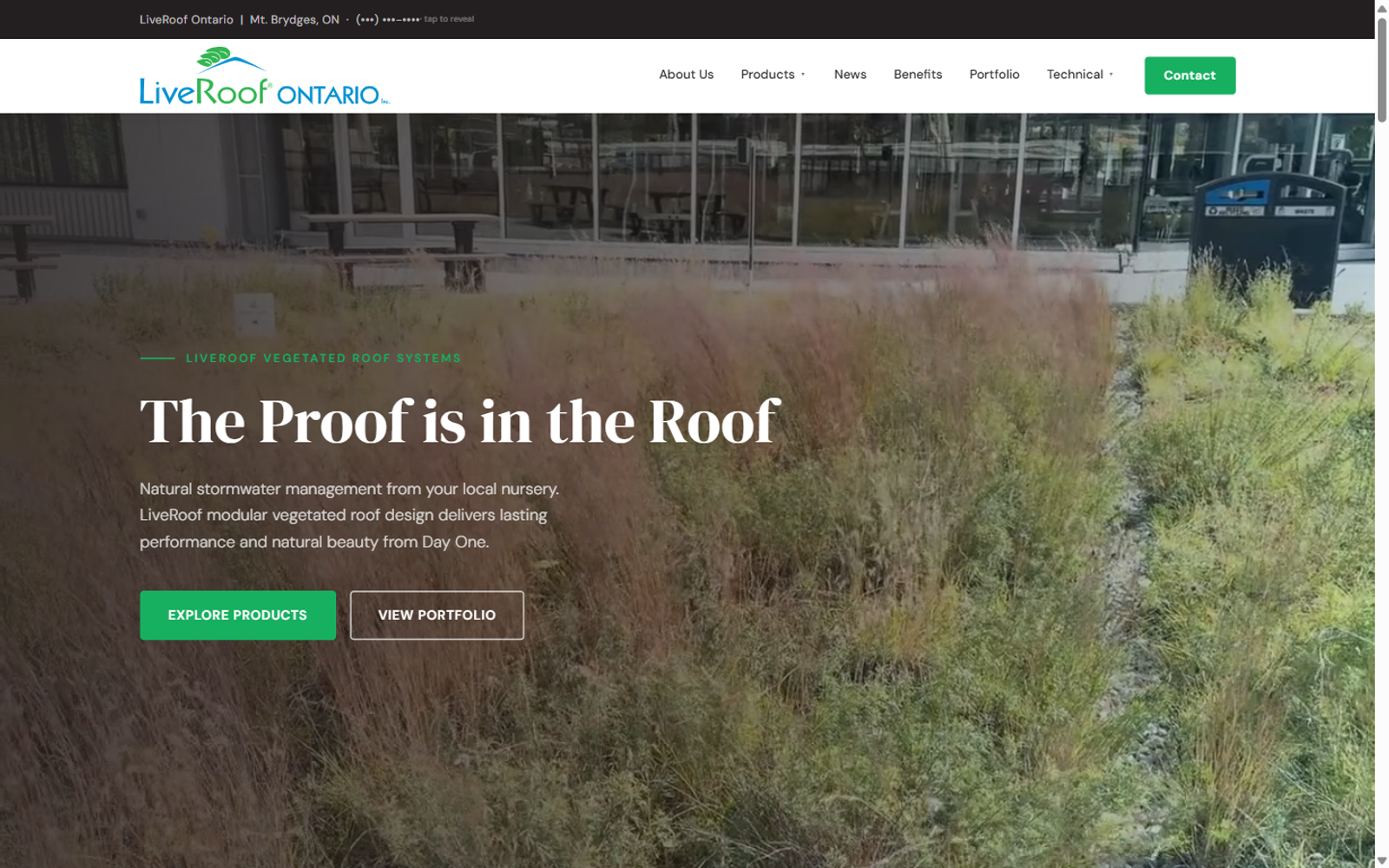
Delivery follows Linova's standard system: Astro components over typed data, static HTML output on Vercel. The hero video paints a poster frame first so nothing blocks the initial render, the contact form posts to Formspree so there is no server to maintain, the phone number sits behind a tap-to-reveal so scrapers can't harvest it, and the whole site runs under a strict content security policy.
what shipped
- Filterable 80-project portfolio
- Filters across six building types, four LiveRoof systems, four LEED tiers, and eight feature tags, with size, install date, and grower on every entry.
- Sanity-driven publishing
- New installs are entered as structured documents and appear in the portfolio with their filters, images served from Sanity's CDN.
- Technical library, eight sections
- Detail drawings in PDF and DWG for every module type plus RoofEdge, RoofStone, RoofBlue, PipeRunner, and SolaGreen, alongside a design guide, LEED resources, and a spec writer.
- Nine product pages
- From pre-grown vegetated modules to SolaGreen bio-solar and RoofBlue detention, each built from the same component patterns.
- Static delivery on Vercel
- Prebuilt Astro pages behind a strict content security policy, with a Formspree contact form and a tap-to-reveal phone number instead of a scrapeable one.
stack
AstroTypeScriptSanity CMSVercelFormspreewant one like it
Book a call.